








Headlines

Researchers tracked 724 Northern Hemisphere lakes from 2000 to 2022; above critical winter temperatures, ice-loss sensitivity rose up to 22-fold and could shorten seasons by 40 days

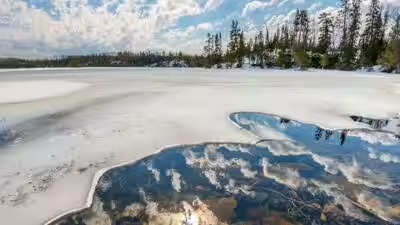
Study says Northern Hemisphere lakes may lose 40 days of winter ice by 2100 (National Geographic photo) Winter ice on lakes plays an important role in keeping lakes healthy by controlling water temperature, supporting aquatic life and helping maintain the natural balance of freshwater ecosystems. However, scientists say this seasonal ice cover is disappearing faster…


Read More

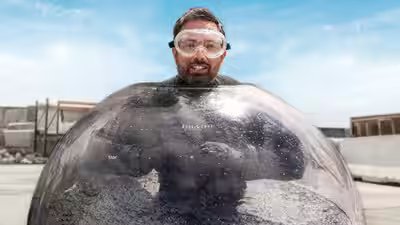
Meet Roy Kim, the 13-year-old Oregon student who designed a chamber that turns moisture in the air into water for drought-hit farms

“Do what you can do tomorrow, today,” says Roy Kim, a 13-year-old Oregon student who has solved the water crisis for numerous farmers in the region. The teenager developed a device that turns moisture in the air into water, helping farmers access a sustainable and reliable source of water in drought-prone areas, as per a…

Read More

A Massachusetts farmer has put 832 tracking solar panels over his crops. The land now grows food, electricity and extra farm income all at once

The Massachusetts project is an example of agrivoltaics, a nascent farming practice that combines agriculture with solar energy generation on the same land. Farmers have relied on sunshine to grow healthy crops for generations. But as they say, excess of anything is bad and with climate change causing hotter summers, longer droughts and erratic weather,…

Read More

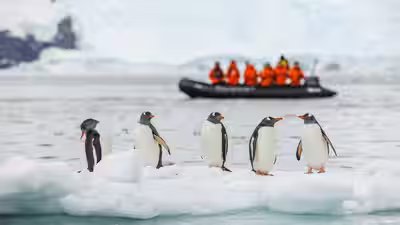
A 14-kilometre iceberg cut off food supply to an Antarctic penguin colony, and chick numbers dropped by 69% in one breeding season

How one iceberg changed everything for Antarctic penguin colony When it comes to nature, it often reminds us that even the smallest change in the environment can ripple through an entire ecosystem. According to experts, in Antarctica, life depends on a fine balance of sea ice, open water and seasonal rhythms. A lone iceberg has…

Read More

Ghana’s capital discards 300 tons of plastic per day, now they mix it with sand and use it as street paving that is cheaper than concrete

Ghana is transforming its plastic problems into paving blocks for its roads, sold below the price of concrete blocks. Behind this operation is Nelson Boateng, who graduated in computer network engineering, and was already manufacturing plastic bags and began transforming the same material into flooring. The plastic Ghana cannot contain Accra, the capital of Ghana…

Read More

Minnesota’s largest coal plant once burned 30,000 tonnes daily; its existing wires now carry 710MW from 1.7 million solar panels powering about 150,000 homes

America is retiring coal plants slowly and steadily. The boilers are cut up for scrap, the smokestacks get dropped on camera and the land tends to sit in permitting limbo for a decade. But in Becker, Minnesota, the state’s biggest coal plant is being used, not for all this hardware but for a plug.On July…

Read More

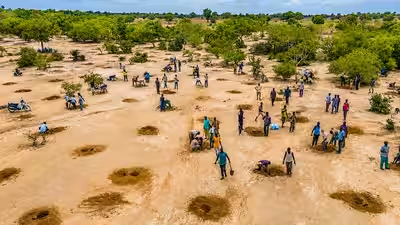
After decades of drought, water is returning to the south of the Sahara Desert as ancient farming techniques and the Great Green Wall breathe new life into the Sahel |

Communities dig water-harvesting pits to restore degraded land and improve soil moisture in the Sahel. For decades, the Sahel has symbolised environmental decline. Stretching nearly 5,900 kilometres across Africa from Senegal on the Atlantic coast to Sudan on the Red Sea, this semi-arid belt has endured recurring droughts, advancing desertification and repeated crop failures since…

Read More

In 1966, scientists wiped out nearly every insect on tiny Florida islands to see how nature would rebuild itself |

Image(s): Florida Key Isaland/Canva Imagine erasing almost every insect and small animal from an island, then watching nature rebuild itself from scratch. That was exactly what a team of ecologists did in the Florida Keys during one of the most influential ecological experiments ever conducted. In 1966, researchers enclosed tiny mangrove islands in enormous plastic…

Read More

Scientists trained 182 pet dogs to sniff out one of America’s most destructive invasive insects, and most successfully found its hidden eggs |

The spotted lanternfly has become one of the most destructive invasive insects in the United States, threatening vineyards, orchards and forests by feeding on the sap of hundreds of plant species. Finding its egg masses before they hatch is one of the most effective ways to slow its spread, but the eggs are well camouflaged…

Read More