









Headlines

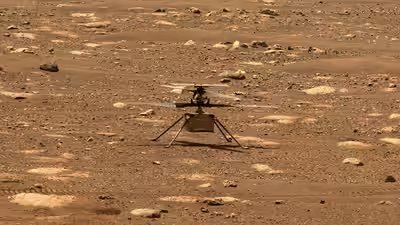
The tiny helicopter Nasa built to survive 30 days on Mars ended up flying for nearly three years |

Nasa’s Ingenuity helicopter/Image: Nasa Flying a helicopter on Earth is a remarkable engineering achievement. Flying one on Mars, where the atmosphere is less than 1% as dense as Earth’s, was once considered nearly impossible. Yet on 19 April 2021, Nasa‘s Ingenuity helicopter achieved the first powered, controlled flight on another planet, proving that aerial exploration…
Read More

How China’s new two-stage plan aims to destroy Earth-bound asteroids before impact

Photo credit: Getty images Chinese researchers have identified what they describe as the most effective way to destroy or deflect a large asteroid threatening Earth by burying a nuclear bomb beneath its surface before detonation.According to a study led by researchers at the China Academy of Launch Vehicle Technology in Beijing, the two-stage approach could…

Read More

In 1974, Spain imported two tons of American red crayfish for aquaculture; 50 years later, the species cannot be removed

Fifty years ago, American red crayfish were introduced to Spain’s Guadalquivir River basin, and they have since established a permanent presence. These aggressive invaders have wreaked havoc on local wildlife and disrupted aquatic ecosystems. Yet, local communities have successfully built an economy around their harvesting and processing. This dependence has sparked legal disputes, resulting in…

Read More

In 2023, scientists turned part of San Diego’s ocean bright pink to see how river water reaches the sea |

Representative Image of an ocean dye experiment tracking how river water reaches the sea (AI-generated image) In January and February 2023, waves along a stretch of San Diego coastline briefly turned a striking shade of fuchsia, the result of a deliberate scientific experiment rather than any natural phenomenon. Researchers from UC San Diego’s Scripps Institution…

Read More

Houston student Aiden Jo, 14, saw bulky packaging as a design problem; his origami-inspired answer reached a national science final

Innovative Minds: Aiden Jo Bulky, single-use food and drink containers continue to take up large amounts of space in rubbish bins and landfills long after they are thrown away. Fourteen-year-old Houston student Aiden Jo saw this as an engineering challenge and came up with an origami-inspired collapsible container. His invention has earned him a place…

Read More

Australia has built bridges just for crabs so millions of red crabs can safely migrate across Christmas Island every year |

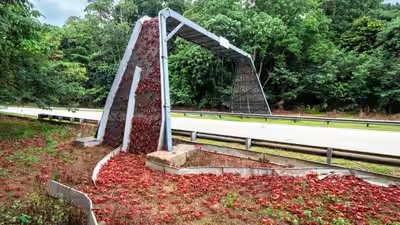
Every year, one of the world’s most remarkable wildlife migrations takes place on Australia’s remote Christmas Island, where millions of bright red crabs leave the rainforest and journey towards the Indian Ocean to breed. As the crabs cross roads, forests and beaches, they create a spectacular natural phenomenon that attracts visitors from around the globe….

Read More

Ahmed: Cambridge student Ahmed Abdelsalam, 12, designed a system that harvests energy from movement; the invention made him one of 10 finalists for a $25,000 prize

12-year-old Ahmed Abdelsalam created energy-harvesting system A 12-year-old student from Cambridge, Massachusetts, has developed a technology that could help find new ways to generate cleaner energy by capturing power from everyday movement.Ahmed Abdelsalam, a sixth-grade student at Darby Vassall Upper School, created VERDA, a system that harvests energy from sources including walking.Ahmed’s project has earned…

Read More

Florida’s first flesh-eating bacteria death of 2026 raises concerns during beach season as warm waters fuel infections |

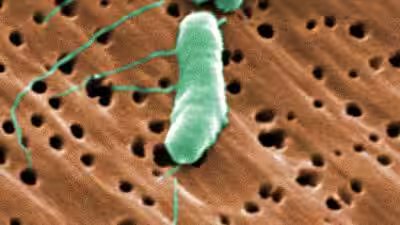
Image Credit: CDC/ Janice Haney Carr Florida health authorities have officially confirmed the state’s first fatality of 2026 linked to Vibrio vulnificus, a naturally occurring ‘flesh-eating bacteria’. This specific death involved a resident of Palm Beach County aged between 80-84 years. According to the BEACON(public health program based at Boston University) , these cases are…

Read More

Louis Pasteur: Quote of the day by Louis Pasteur: “Chance favours the prepared mind.” – why preparation matters more than luck |

Louis Pasteur’s famous quote, (AI-generated image) Two scientists can stumble into the same unplanned accident in the lab and walk away from it completely differently. One sees a ruined experiment, discards it, and starts again from scratch. The other recognises, almost instantly, that the accident has revealed something nobody had intentionally set out to find….

Read More

In 1987, Victoria began an A$26 million experiment inside a mountain ash forest; three decades later, the results surprised researchers

In a pioneering study within Victoria’s mountain ash forests, surprising findings have emerged over extended periods. Intense thinning of trees fostered lush growth and increased diameters in the surviving trees. These enhanced specimens exhibit greater fire resilience and are likely to create hollows for various wildlife. Interestingly, Leadbeater’s possums thrived in thinned and acacia zones,…

Read More